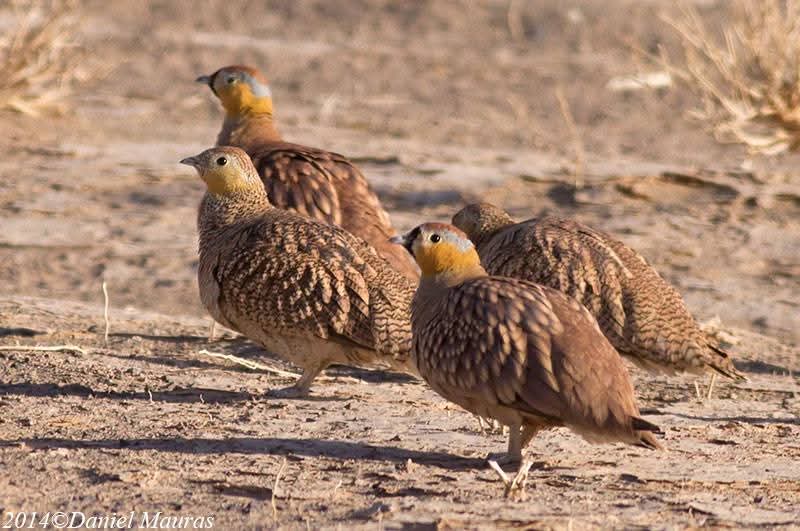
The Crowned Sandgrouse is a remarkable desert bird perfectly adapted to survive in some of the harshest environments on Earth. Found across the Sahara and surrounding regions, it is known for its endurance, long-distance flight, and ability to live in extremely dry conditions.
Physical Description
This medium-sized bird has a compact body and long, pointed wings designed for fast and direct flight. Its sandy, finely patterned plumage provides excellent camouflage in desert landscapes.
Males are especially distinctive due to a subtle crown-like pattern on the head, which gives the species its name. Overall, its appearance is both simple and perfectly suited for desert survival.
Distribution and Habitat
The Crowned Sandgrouse is widely distributed across North Africa, the Sahara, and parts of the Middle East. It prefers open sandy plains, gravel deserts, and dry valleys where vegetation is limited.
These environments allow it to travel long distances in search of water and food.
Behavior and Ecology
This species is highly adapted to life in arid environments. It often forms small flocks and travels long distances daily, especially during early morning and late afternoon.
One of its most fascinating behaviors is its ability to transport water using specialized belly feathers. Males soak their feathers at water sources and carry the water back to their chicks, allowing them to survive in dry areas far from water.
Vocalization
The Crowned Sandgrouse produces soft, low calls, often described as short “kuk” or gentle cooing sounds. These calls are mainly used for communication within flocks, especially during flight.
Conclusion
The Crowned Sandgrouse is a true symbol of resilience in the desert. Its unique adaptations, long-distance travel, and ability to survive in extreme heat make it one of the most fascinating birds of the Sahara.
Want to See Sandgrouse in Merzouga?
Contact Sahara Birding Merzouga and experience the unique behavior of desert birds with a local expert guide.
Contact Us