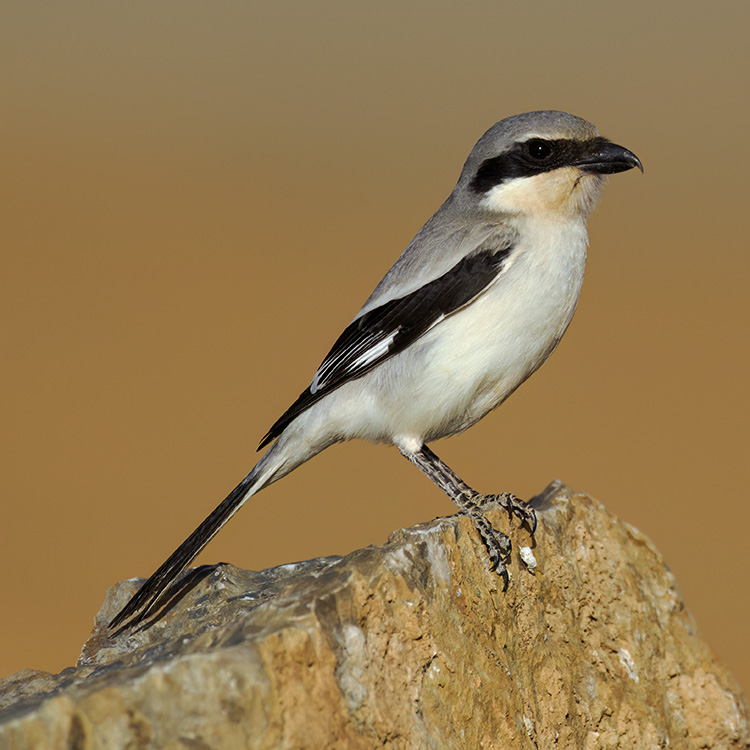
The Great Grey Shrike is a striking predatory songbird known for its bold behavior and sharp hunting skills. Often called the “butcher bird,” it is famous for its unique feeding habits and can be found in open landscapes across North Africa, including the desert edges around Merzouga.
Physical Description
This medium-sized bird has a grey back, white underparts, and a distinctive black mask across its eyes. It has a strong, slightly hooked beak, similar to birds of prey, which helps it catch and kill insects, small birds, and rodents.
Its appearance is sharp and elegant, making it easy to recognize when perched in open areas.
Distribution and Habitat
The Great Grey Shrike is found across Europe, Asia, and North Africa. In desert regions, it prefers open habitats such as steppe, scrubland, and desert edges.
It often chooses locations with scattered bushes, trees, or poles, which it uses as vantage points for hunting.
Behavior and Ecology
This species is a skilled hunter despite being a passerine bird. It typically hunts by sitting on a high perch and watching for movement before swooping down on its prey.
One of its most remarkable behaviors is impaling prey on thorns or barbed wire, which it uses to store food. This behavior is what gives it the nickname “butcher bird.”
It is usually solitary and territorial, defending its hunting area from other birds.
Vocalization
The Great Grey Shrike produces a mix of soft whistles and harsher notes. Its calls are used mainly for communication and territory defense. While not very loud, its voice is clear and distinctive.
Conclusion
The Great Grey Shrike is a powerful and intelligent predator of open landscapes. Its unique hunting techniques, bold personality, and striking appearance make it one of the most fascinating birds to observe in the Sahara and surrounding regions.
Want to See the Great Grey Shrike in Merzouga?
Contact Sahara Birding Merzouga and explore the desert with a local guide to observe fascinating bird behavior up close.
Contact Us